Interview with Big Data engineer in 2026
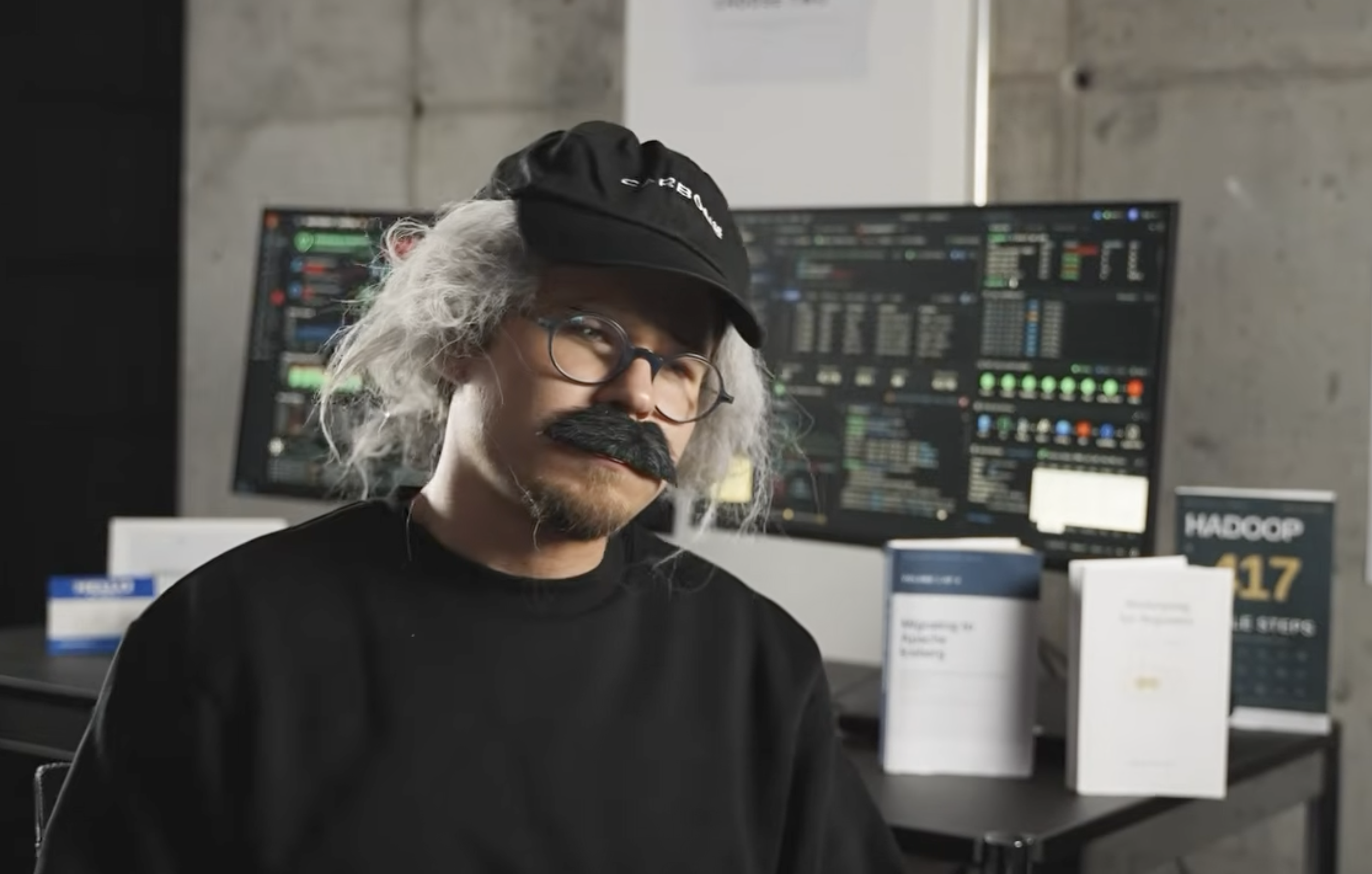
I love this parody “Interview with Big Data engineer in 2026” so much that I started noting down every hilarious quote I heard. And, apparently, it’s almost a complete transcript. Hope you’ll enjoy it as well :-).
We built a real-time pipeline, so leadership can ignore insights… at millisecond speeds. 00:00
Big data. Most companies don’t actually have big data, they have medium data. Big data is anything that crashes Excel. 00:25
We actually have two big datas… for fault tolerance. 00:33
Two wrongs don’t make a right… except in a distributed database. 00:36
Big data is different math. 1+1 ≈ 1.9. 95% confidence interval. 00:40
Our 15-million-row dataset has 800 columns. The rows aren’t wide. They are panoramic. 00:47
If the join fits in memory, it belongs in Postgres. 00:54
Our architecture preserves every invariant except the budget. 00:57
Our cloud bill was $340,000. We don’t know if the processing even ran. That was just observability. 01:01
We support real-time processing, of course, unless the event arrives early, late, duplicated, malformed, reordered. 01:08
Eventual consistency was too hard, so we went with ‘immediately inaccurate’. 01:18
70% of records are accurate. That’s higher than the weather forecast. 01:22
The numbers are not wrong. They are early. Wait two, three, maybe… four days, they will be late. 01:26
‘Final numbers’ mean numbers we have stopped refreshing… 01:35
The slide says we handle billions of events. It does not say we handle them well. 01:40
It is only truly idempotent if all availability zones go down equally during the outage. 01:45
Management asked us to build a data lake, but it wasn’t scalable enough. So McKinsey asked us to build a data swamp. 01:51
The project was declared successful before all the metrics arrived. We call that watermarking. 02:01
The dashboard is green because the job that checks if the dashboard is wrong is red. 02:07
A production workaround becomes durable the moment the engineer who wrote it leaves. 02:17
Yes, we removed an unused column, and it broke Portugal. 02:22
The bug has existed for eight years. At this point, it’s an interface. 02:26
This is our architecture. Very simple. Kafka, Airflow, Databricks, Flink, Spark, SQL, Iceberg, S3, Presto, dbt. 02:35
What does dbt stand for? Dialectical behavioral therapy. 02:46
We have the most modern stack in the industry. Only 10% is COBOL. 02:51
HDFS is not dead. It’s waiting for someone with root access. 02:56
We migrated from cron to Airflow for reliability. Then we wrote a cron job to check if Airflow silently died. 02:59
We would switch from Databricks to Excel. If it wasn’t for date parsing. 03:06
We are a data-driven company, of course. Every week somebody reads the invoices out of PDFs and types the data into Excel. Running on Kubernetes. 03:11
We moved from Hive tables to Iceberg tables because we wanted the metadata to fail… to fail with better governance. 03:20
Whenever we lose a backup, we reconstruct what the customer did from the logs. No, that’s one of our industry’s best practices. 03:30
Our customers didn’t even know. To be honest, most of our customers don’t even use our product anyway. 03:38
The board deck says petabyte scale, yeah. Scale is a direction, not a quantity. I checked with legal. 03:43
Management says 1PB. I checked, yeah, we only process 18TB, but we round up. 03:49
Our P99 is 4 minutes, but the P50 is excellent, and most people are median. 03:55
Streaming gets simple once you understand watermarks, event time, processing time, state, backpressure. 04:02
Batch and streaming produce different numbers. We average them. 04:10
Our recommendation pipeline had three hours of Kafka lag. So technically it was a real-time recommendation for your past self. 04:16
We decoupled storage and compute. Now the storage team and the compute team have separate outages. 04:27
The data team? The data team has excellent isolation. We haven’t spoken to Product in seven months. 04:37
All problems become your problems at 1TB/hour. 04:43
Exactly-once processing is easy. You just need… two topics, transactions, offsets, recovery states, and a relaxed interpretation of “easy.” 04:47
GDPR in a data warehouse. There’s a funny joke. 04:57
We anonymized the data… by removing the column ‘name’. 05:00
We persist it in places nobody knows how to query. 05:04
The only thing in this company with strong durability is a bad architectural decision. 05:07
Salary, job security, holidays, pick two. CAP-compliant. 05:13
Can we have this by Friday? In distributed systems, what does Friday mean? Before the meeting, it’s only a partial order. 05:18
The project isn’t late. The clocks just disagree. It’s a distributed organization. 05:26
Every quarter, we solve capacity problems… by increasing input. 05:31
We maintain system availability by shedding… by shedding Jira tickets. 05:35
Last year, they fired 80% of our team as part of our… “operational transformation.” They should have used CRDTs instead. 05:40
A backfill is when you fix one historical bug by introducing one historical bug by introducing one historical bug by introducing a brand-new historical bug. 05:48
The Snowflake warehouse runs a 2-second query every minute. Very sophisticated way of never letting it turn off. 05:54
Artificial intelligence? No. We still rely on human… human single point of failure. 06:01
We migrated to Apache Iceberg this year… Quick 43-month migration. 06:33
We still use protobuf. Yes, we are still confused, but at least confused… strongly typed. 06:39
Some say data is the new oil. We cannot stop producing it, and we will pay to clean it up for years. 06:45
From what I see, data is the new asbestos. 06:53
The AI teams… spent $4 million and it called investment. I spent $340,000… and this called a review. 06:55
I’m in a FinOps review every Thursday. The AI team has never, ever been to FinOps. They have a different word for money. 07:03
My cluster is a cost center, their cluster is a strategy. Same rack in AWS. 07:11
A soft outage is when the checkpoint directory grows faster than S3 versioning can bill. 07:24
Back in the days, big data means you bring the intelligence to the data. That’s why I go straight to Big Data center. We have two big data centers… for fault tolerance. 07:31
But the team came with Airflow graph. We use what? 1, 2, 3, 4, 13, 14, 23, 6400 services… just to clean the logs. 07:54